
Eastvale Resident Lookup Record Map
A one-person Eastvale resident lookup crosses custodians because no single public roll answers ownership, registration, court activity, family facts, and professional affiliation at once. Start with the record that matches the known clue. An address points toward the assessor and recorder. A court number is better than a common name. A family-history question may require a vital application or an archive. The coverage map keeps those paths separate.
| Record | What It Confirms | Where to Search | Access |
|---|---|---|---|
| Assessor parcel record | APN, situs, assessment context, and owner through office access | Riverside Property Search | Free address or APN web search; owner at ACR office computers or microfiche |
| Recorded instruments | Party role, deed chain, document type, date, and legal description | Riverside Recorder index | Free index; copies through web, counter, mail, or Gateway |
| Superior Court index | Case category, party names, case number, filing date, and event chronology | Riverside Superior Court public access | Paid name credits; case-number and courthouse limits apply |
| Vital certificates | Birth, death, public marriage, or limited dissolution facts | Riverside County Clerk-Recorder or state vital service | Authorized or informational copies under California rules |
| Voter registration | A named voter's status, residence record, precinct, and election details | California My Voter Status | Self-lookup or approved voter-file request, not an open name list |
| Business and licenses | Entity, agent, license status, discipline, or public affiliation | SOS bizfile and DCA searches | Free online search; product-specific limits |
| Unclaimed property | Possible past name, city, ZIP, or property-ID link | California ClaimIt | Free search; a result is not current residence proof |
The order depends on the question. An old address can lead to an APN and deed chain. A school connection can lead to yearbooks. A court case number can lead to a register of actions. A public filing can connect a person to a business without proving that the person lives in Eastvale. Each result should be copied with its date, role, and source.
Match Two Records in Eastvale
The central safeguard in an Eastvale resident lookup is the two-record match. A common name can appear in a deed, court docket, license file, or newspaper without belonging to the person being researched. Begin with a known name variation, approximate date, address, business, school, or family link. Then seek a second fact that the first record could not have supplied by itself.
- Write down every known spelling, middle initial, former surname, approximate date, and Eastvale or Corona locality.
- Use the address or APN route when property may be involved, keeping the assessor's owner entry separate from occupancy.
- Search court categories, recorder names, or official indexes with the same spelling and narrow by date or role.
- Compare a second fact such as an APN, business address, court number, spouse, date, or school connection.
- Save the exact source, date checked, and uncertainty instead of merging two records because the name looks close.
For an old address, the chain is address to APN, APN to office-held owner, owner to recorded deed, and then deed or directory to an earlier person. For a current name, the chain may be court party to case number to available register of actions. For family history, a directory, yearbook, obituary, or cemetery entry can be the first clue, while an official vital or court route supplies the next check. The goal is a defensible connection, not a larger pile of names.
Eastvale Property Ownership Is Not Occupancy
The Riverside assessor web tool accepts APN, PIN, or property address. It can establish the parcel and assessment context, but owner names are not displayed on the public web. Riverside ACR office computers and microfiche provide the public ownership channel. The assessor roll lists an owner for tax administration. It does not list every person who uses the property.
Situs is the physical property location. Mailing address is the correspondence destination. A match between the two can be consistent with owner occupancy, while a difference can be consistent with an offsite mailing contact. Neither proves who sleeps at the address. Trusts, companies, agents, and lien roles need separate deed or business-record checks. Record the roll date because owners and mailing destinations change.
Use Riverside ACR's assessor services route to confirm office access and public-terminal information. If the public web search returns an APN, carry that nine-digit identifier into the recorder and GIS steps. An assessor result is one part of an address lookup, not an occupancy roster.
- APN
- The assessor's parcel number, used to carry a land identity across maps and related records.
- Situs
- The physical location of the parcel, distinct from the mailing address.
- Occupancy
- A fact about use or presence that the property roll does not establish by itself.
- Recorded party
- A person or entity named in an instrument. The role may be grantor, grantee, trustee, lender, or lienholder.
Riverside Court Search for One Resident
Eastvale has no separate municipal trial court. Local trial cases go to Riverside Superior Court, whose public access categories include Civil, Criminal, Family Law, Probate, and Traffic. The online name mode uses paid credits, while a case number is the cleaner retrieval path when one is known. The portal's result lead is a case title, party names, case number, case type, and filing date. A register of actions adds event chronology when available.
| Case category | Civil, Criminal, Family Law, Probate, or Traffic. Choose the category before searching. |
|---|---|
| Name search | Paid person workflow; vendor subfields were not crawlable. One name uses one credit. |
| Case number | Alternate direct-retrieval field when a citation is known. |
| Result inventory | Case title, party names, case number, type, filing date, and possibly a register of actions. |
Online name credits are listed as $1 for one name, $3.50 for five, $5 for ten, $25 for 75, and $250 for unlimited access for 30 days. The clerk's search route costs $15 per name and returns case-number information. Online documents cost $1 per page for the first five pages and 50 cents after that, capped at $50 per document. Check the live court page before payment.
Coverage varies by branch and category. Civil records include Corona from March 1994 and Riverside from October 1991. Family Law begins around April 1992 in nearly all branches. Probate begins around July 1994 in nearly all branches. Riverside felony coverage begins in January 1990 and misdemeanor coverage in January 1994. A missing case may be older, purged, sealed, confidential, or outside the stated branch range.
Rule 2.503 and Eastvale Court Access
California Rule of Court 2.503 explains why an online name hit does not always open the underlying file. Full electronic family, juvenile, guardianship, conservatorship, mental-health, criminal, minor-compromise, harassment or violence, elder-abuse, and gun-violence records can remain courthouse-only even when an index exists. Sealed and confidential records remain unavailable. The courthouse terminal is therefore a real access channel, not a defect in the name search.
The California remote court-record access rule is represented below. It is useful when a resident lookup needs to distinguish a public index, a remotely viewable document, and a record that must be reviewed at the court.
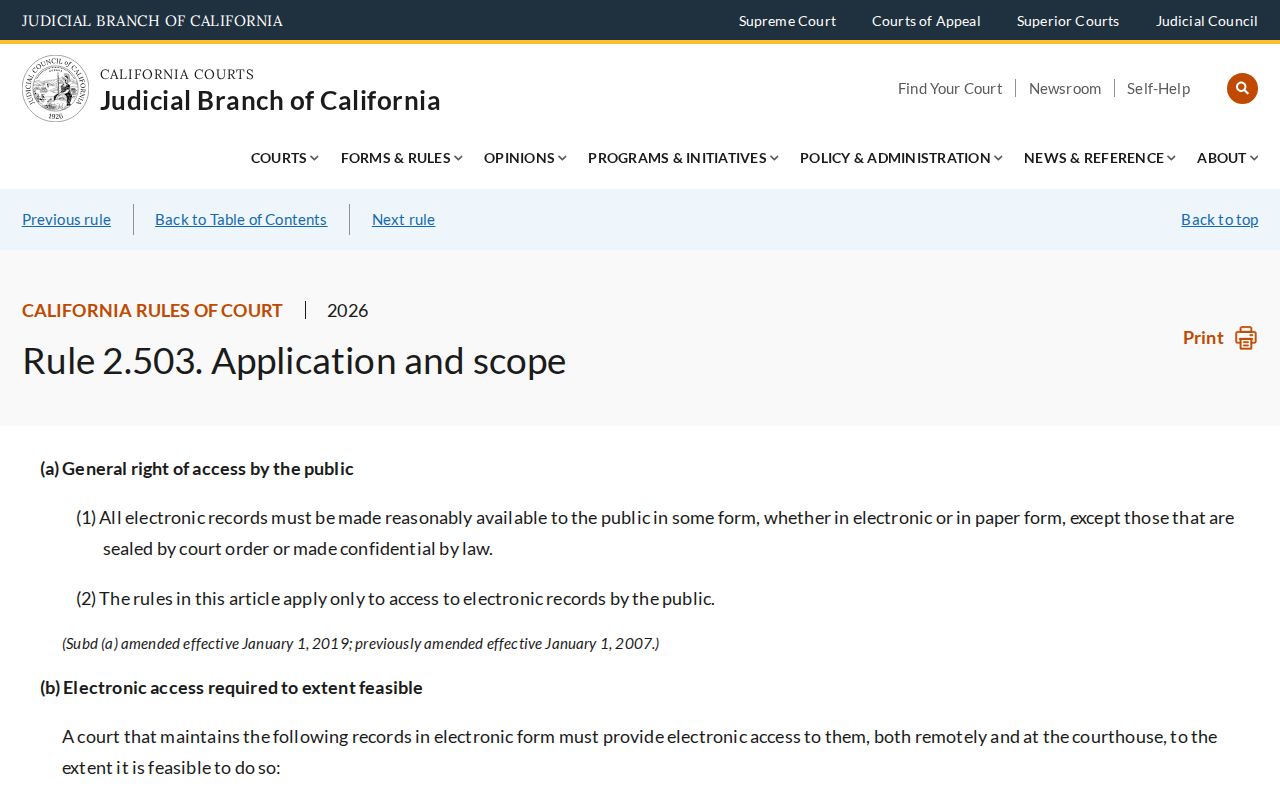
Read a party result as an identity lead, not a finding of wrongdoing. Confirm branch, party role, filing date, case type, and case number before connecting it to an Eastvale person.
Federal matters follow a separate route. Eastvale falls within the Central District of California Eastern Division, and PACER is the federal docket channel. The Riverside Courthouse address in the research is 3470 Twelfth Street, Room 134.
The Central District federal records page shows the federal channel used for a different court system.
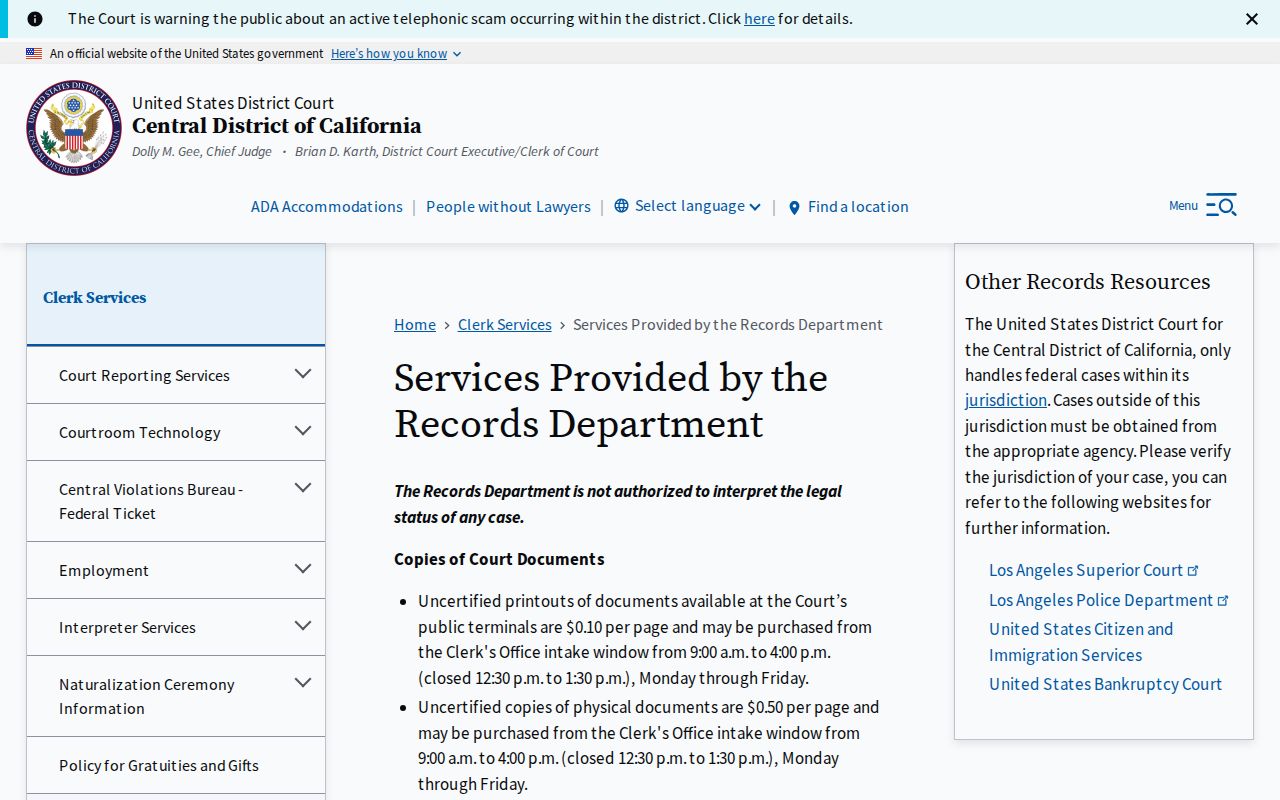
A state index and a federal docket should never be merged solely because names match. The court, jurisdiction, and number must agree.
California Vital Rules for Resident Lookup
California does not use a simple age rule that opens every birth, death, or marriage record after a fixed number of years. Health and Safety Code sections 103525-103526 distinguish authorized copies from informational copies. An informational copy can support genealogy but is stamped not valid to establish identity. Authorized birth, death, and public-marriage copies require the relationship and identity steps set by statute. Confidential marriage copies generally remain limited to a party, and adoption originals generally require a court order.
| Record | Custodian and range | Access | 2026 fee |
|---|---|---|---|
| Birth | Riverside event records after transfer; CDPH statewide since July 1905 | Authorized or informational copy | County $34; state $31 |
| Death | Riverside event records after transfer; CDPH statewide service | Authorized or informational copy | $26 |
| Public marriage | Issuing county; CDPH 1905-1999, 2001, and 2008-2025 | Authorized or informational copy | $19 |
| Confidential marriage | Issuing county | Party-restricted route | $19 |
| Dissolution certificate | CDPH limited abstract; decree at the court | Application or court route | $18 |
The state vital-records service cannot issue public marriage copies for 2000 or 2002-2007. County is usually the practical route for a Riverside event, while the statewide service is the fallback. State applications include identity, relationship, purpose, signature, and sworn-statement fields. A no-record search retains the fee and produces a Certificate of No Public Record.
For a family-history lookup, choose informational or authorized access honestly. A notarized statement verifies the applicant's signature and eligibility process; it does not turn an uncertain historical fact into a proven one.
Eastvale Voter Lookup Access Rules
California My Voter Status is a self-lookup, not a public name directory. It asks first name, last name, date of birth, and conditional California driver license or identification details or the last four Social Security digits. The result can show registration status and address, party and language preferences, polling place, upcoming election information, vote-by-mail or provisional status, and county contact. Recent registration can take 24 hours to process.
Voter-file access is a separate channel. Elections Code section 2194 limits approved purposes to election, scholarly, journalistic, political, or governmental work. A statewide file costs $100. A specific-voter request can cover up to ten named records, requires full name, date of birth, county, and residence address, and costs $30 per record with a $100 cap. The file can include name, date of birth, registration date, residence or mailing address, precinct, contact information, party preference, optional election history, and optional district data. Driver-license, Social Security, unique-identifier, and signature fields are excluded.
Applications go through the Secretary of State's approved route, while the Riverside Registrar at 2720 Gateway Drive, Riverside, can be reached at 951-486-7200. The registrar accepts public-record requests in person, by phone, mail, email, fax, or NextRequest. A voter record confirms a registration residence claimed or maintained for election administration. It is not a continuous presence log and cannot be used to list unidentified people on a street.
Use the California voter-file request rules and the state voter-file application when the question is an approved records project rather than a personal self-check.
Eastvale Business and License Checks
Public affiliation records can help separate two people with the same name. California bizfile covers corporations, LLCs, limited partnerships, and nonprofits. A basic search uses name or file number, while Advanced adds entity type, group, status, initial filing date, and begins-with controls. Results can show entity number, formation date, status or standing, jurisdiction, street and mailing addresses, agent for service, and statement due date. Free filing PDFs may include formation, amendments, statements, and terminations.
The California SOS Business Search does not collect beneficial ownership, so an agent is a statutory service contact and may not be an owner. Fictitious business names are county filings. The California Department of Consumer Affairs search accepts board, license type, license number, business name, first name, last name, and registry number, with status and public discipline in a typical result. Some boards use their own portals.
California ABC supplies address, business-name, city, and ZIP modes for selected license reports. That can associate a licensee or regulated premises with 91752 or 92880, but it does not prove a personal residence. DRE, CSLB, Bar, medical, and nursing records have their own scope and field rules. A license is a regulatory record, not a household record.
Unclaimed property offers a different clue. Its search accepts last or business name or property ID, with first name, city, and ZIP as optional refinements. Exact names appear before similar names. A result may suggest a past address or business link, but the claim process and private evidence review do not establish current residence.
Check the California DCA License Search after the name and date have been narrowed. A public affiliation is useful only when it matches another record's role, location, or time.
Human Uses for an Eastvale Resident Lookup
Official records serve people, not just database questions. An heir may start with a deed, probate case, obituary, or county archive and then verify the relationship through the proper court or vital channel. A former classmate may be easier to place through CNUSD yearbooks, Corona Heritage Online, and school-era newspaper notices. A birth-family question belongs with official adoption, court, and CDPH procedures, not public guessing about a protected person.
Corona Heritage Online contains roughly 6,000 photographs, yearbooks, portraits, residence images, maps, scrapbooks, and community items. The Corona Genealogical Society supports more than 50 free library programs each year and can help frame a question before a repository visit. These sources add human context, but a photograph or yearbook line still needs a date and a second fact before it is tied to a modern resident.
For an estate, keep the person role clear. A deed party, probate interested person, obituary subject, school alumnus, business agent, and licensee are different records. A resident lookup becomes more reliable when it says which role was actually found.
The Corona Heritage Online collections are a useful starting point for a classmate or community-memory question.
CPRA Requests for Eastvale Record Gaps
When a portal ends, make a defined request to the custodian rather than asking the city or county to research a person. California's Public Records Act, Government Code sections 7920.000-7931.000, allows any person to request existing records. An agency generally gives an initial determination within 10 days and may use a written 14-day unusual-circumstances extension. Inspection is generally free; ordinary copies are limited to direct duplication cost, and extraction or programming can have a separate charge under the statute.
Eastvale's City Clerk route offers Submit a Public Records Act Request, Search Public Documents, and Search Building Permits. City Clerk Marc A. Donohue is listed at 12363 Limonite Avenue Suite 910, Eastvale, California 91752, with phone 951-703-4420 and cityclerk@eastvaleca.gov. City Hall hours are Monday through Thursday, 7:30 a.m. to 5:30 p.m. A useful request names an address, record type, department, and date range. Personnel records, current litigation, and current real-estate negotiations can be exempt.
The California DOJ Public Records Act guidance is represented below. It is an access route when the local portal or a dynamic form does not answer the record question.
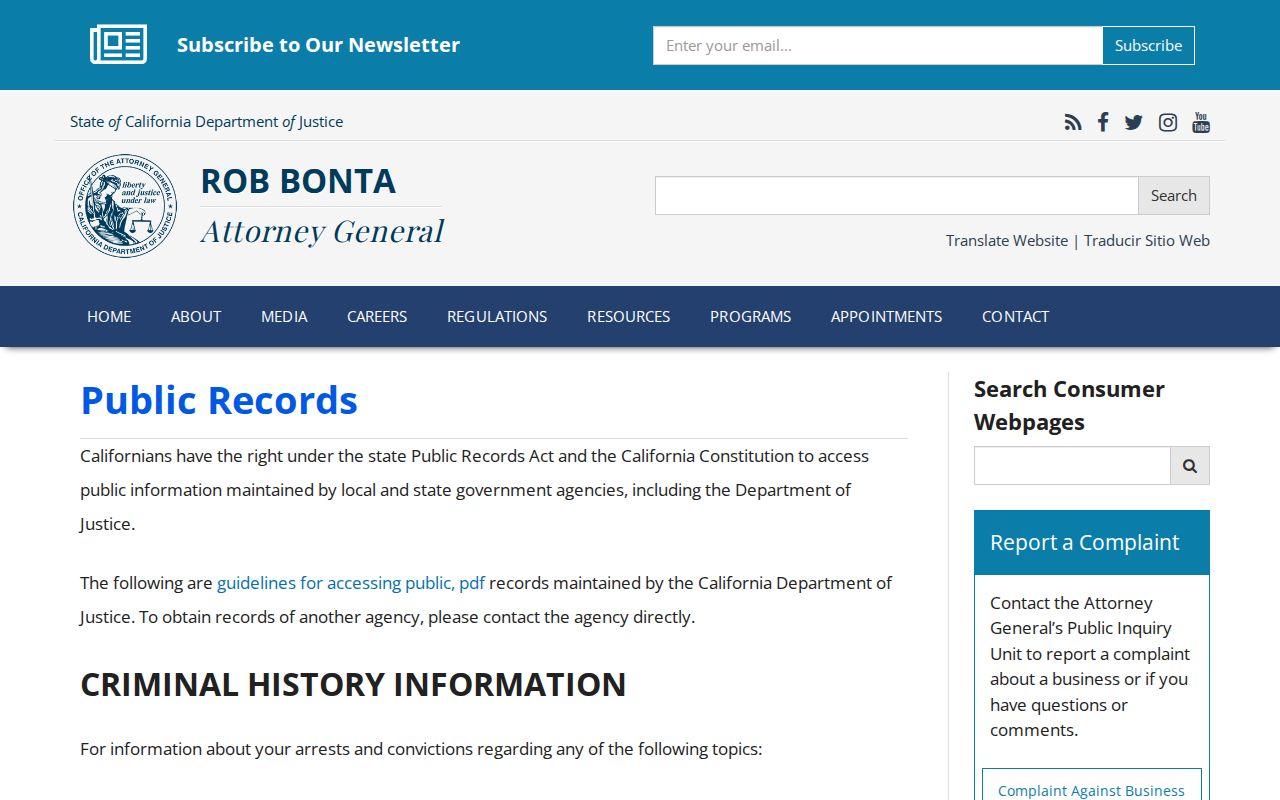
Use the public-records request to seek a record the agency keeps. It does not require the agency to create an Eastvale residents list, answer a research question, or disclose material that another law protects.
For county property and deed gaps, use ACR office, counter, mail, and Gateway routes. For vital records, use Riverside County or CDPH applications. For court gaps, use the clerk search or courthouse access. The fallback should follow the record's custodian.
Privacy Boundaries for an Eastvale Resident Lookup
California's Safe at Home program supports qualifying victims of domestic violence, stalking, sexual assault, child abduction, elder or dependent-adult abuse, trafficking, and specified threatened affiliates. Government Code section 6208.1 restricts public display after the required written demand and harmful publication. Protected voter records are omitted from ordinary voter-file products.
California privacy rights also work differently against businesses than against government records. The CCPA provides rights to know, delete, correct, opt out of sale or sharing, limit sensitive-data use, and avoid discrimination, subject to exceptions. The 2026 DROP program sends one encrypted deletion request to more than 500 registered data brokers. It cannot erase a deed, court file, assessor instrument, or other official record, and it does not replace Safe at Home.
Use a privacy link or registry with a commercial compilation service, keep the confirmation, and repeat for aliases when needed. A derived result can be stale or mismatched. Verify a record with the custodian, keep the source role intact, and stop when the purpose no longer fits lawful personal research.
Lawful use. An Eastvale resident lookup may support genealogy, reconnecting with a classmate, estate research, or civic verification. Do not use a name, address, court result, voter record, or public affiliation to stalk, harass, intimidate, or harm another person.
The California Safe at Home guidance and the California consumer privacy guidance explain the two privacy routes. A missing result can be a protection, not an error to work around.
Note: Court credits, certificate fees, voter routes, and office contacts were checked in August 2026; confirm live terms before submitting sensitive information.