
Eastvale's Historical City Directory Shelf
Eastvale does not have a verified long-running printed directory under its present city name. The useful shelf is regional. The founding-year volume, Corona Public Library's microfiche, Corona Heritage Online, Riverside County Archives, and NARA Riverside together cover different kinds of historical evidence. The collection map below separates the exact runs from holdings whose individual years still need a local check.
| Collection | Years | Where Held | Access |
|---|---|---|---|
| History and Directory of Riverside County, 1893-4 | 1893-94 | Library of Congress | Free images, OCR, PDF, and download |
| Riverside City and County Directories | 1889-1966 | Corona Heritage Room microfiche | Onsite reader; call ahead for offsite items |
| Corona volumes | Select years; exact run not listed | Corona Heritage Room hardcover shelf | Onsite research; verify desired year |
| Corona Heritage Online | Varied historical items | Digital collections portal | Free online photographs, yearbooks, maps, and memory items |
| U.S. telephone directories | Most of the 20th century | Library of Congress digitized microfilm | Search online; confirm local reel coverage |
| Federal census and naturalization records | Public census through 1950 | NARA Riverside, Perris | Appointment research, Monday-Friday, 9-4 |
The table has a useful gap built into it. The Library of Congress volume is a single, free, public-domain book. The Heritage Room's 1889-1966 wording verifies a broad microfiche run, but it does not promise every year, every Corona volume, or a reverse section in every edition. A careful collection search records the title, publication year, repository, and access mode before relying on a line.
Why Eastvale City Directory Years Split
Place identity changed faster than the printed record. Riverside County was formed in 1893 from territory that had followed predecessor counties. “East Vale” appeared as a school-district name, while Corona supplied postal, school, newspaper, and library identity. Norco and rural route descriptions can also point toward the present Eastvale area. The city incorporated on October 1, 2010, so the municipal era is much newer than the historical resident trail.
Search the historical volumes with East Vale, Eastvale, Corona, Norco, rural routes, ranch names, and county sections. A Corona mailing line may describe postal geography rather than a municipal boundary. ZIP history adds another clue: 92880 accepted Eastvale as a city name beginning January 1, 2024, while older records can accurately say Corona. A modern city-name search alone will miss people whose records were created before that wording existed.
The official Eastvale history page supplies the local incorporation, school, dairy, and naming context. The regional shelf should preserve those older names rather than normalize them away.
The Eastvale council agenda and minutes archive below is not a directory shelf, but it marks the point at which Eastvale's own civic record begins.
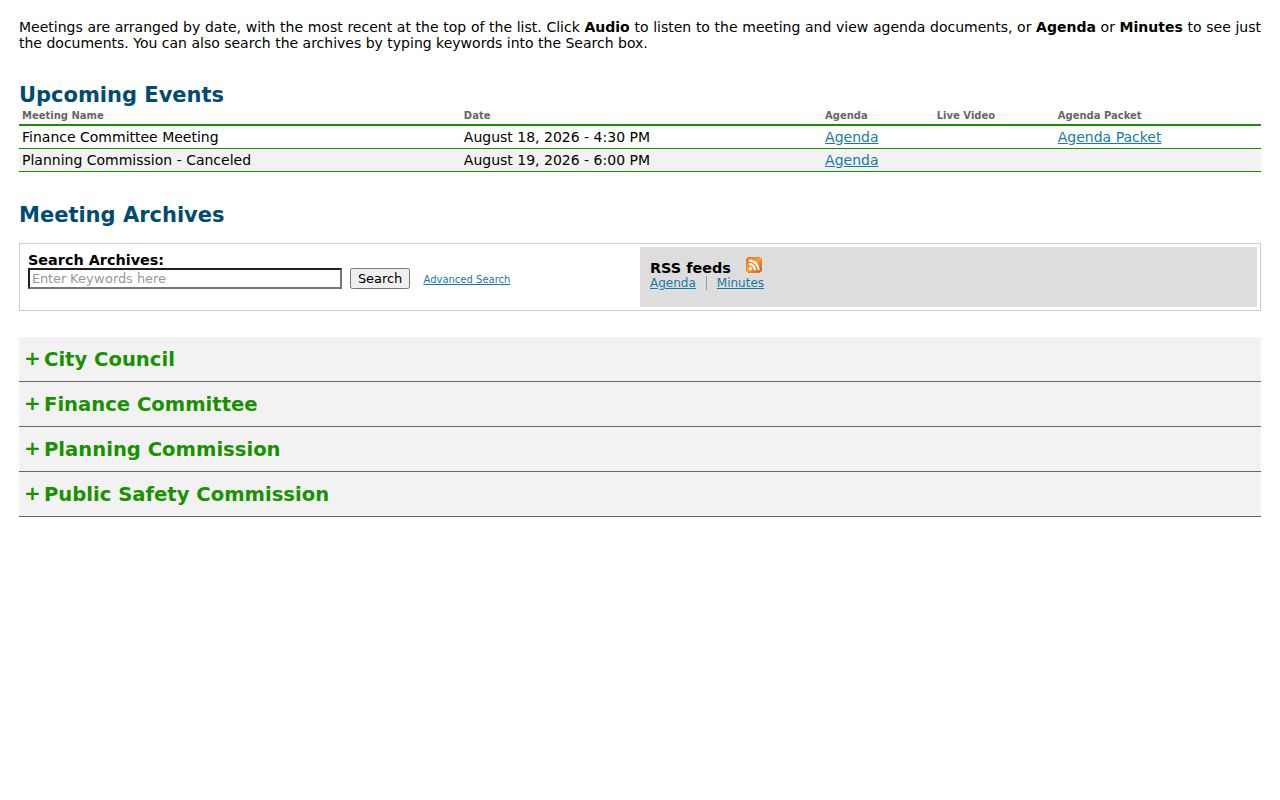
Eastvale council agendas and minutes help date the post-incorporation layer. They should be used alongside, not substituted for, the older regional volumes.
The 1893-94 Eastvale City Directory
The Library of Congress copy of History and Directory of Riverside County, 1893-4 is the strongest early online starting point. A. A. Bynon and Son prepared it for the Riverside Daily Press Job Office in the county's founding year. The catalog provides 360 images, OCR, PDF, download, and IIIF-style image access. The volume combines narrative history with directory sections, so the surrounding pages can explain schools, settlements, officials, and businesses even when a precise East Vale line is not safely verified.
Search the page images and OCR together. OCR may miss a surname, turn “East Vale” into another word, or blur initials. Check the printed page before copying a name. Use the alphabetical and locality headings, then note the post-office designation, residence or ranch description, occupation or business, and any cross-reference. The book is public domain, but a build or family history should never invent a person line that was not verified in the image.
Free versus onsite. The 1893-94 volume can be inspected online at no charge, while the longer 1889-1966 directory run is an onsite Heritage Room resource. Use the free volume to learn the period's vocabulary before planning a fiche visit.
This founding-year convergence is an Eastvale research story: county creation, the East Vale school name, and the first directory evidence meet in the same period. It explains why a regional directory search reaches beyond a modern city label.
Corona Heritage Room City Directories
The W. D. Addison Heritage Room at Corona Public Library is the key local stop for the regional directory shelf. It verifies Riverside City and County directories from 1889-1966 on microfiche, selected Corona volumes in hardcover, newspapers, California death and marriage indexes, cemetery information, and local genealogy materials. The room is at 650 S. Main Street, Corona, California 92882. The phone is 951-279-3593 and the email is Heritage.Room@CoronaCA.gov.
Recorded hours are Monday through Thursday, 10 a.m. to 7:45 p.m.; Friday, 10 a.m. to 1:30 p.m. and 2 to 5:45 p.m.; and Saturday, 10 a.m. to 1:45 p.m. Offsite material needs advance notice. Closed-hours appointments Tuesday through Thursday should be requested about a week ahead. Ask before photographing and use no flash. Copies and scans cost 25 cents, scan-to-email is unavailable, and a flash drive is the practical way to carry scans. A high-quality digital reproduction costs $7.50 per image and publication permission is required.
The Corona Heritage Room genealogy holdings page is the place to confirm whether the desired year is on fiche, in a hardcover volume, or offsite. Staff help is especially valuable when a directory's title uses Riverside County rather than Eastvale.
Directory access is a physical research task as well as a search task. Bring alternate locality spellings, approximate years, and a note of the question being tested. The room also supports a surname with newspaper, cemetery, and index cross-checks.
Reading an Eastvale City Directory Line
A printed entry is a compact historical record. It may identify a person, a household connection, a business, and a locality in one line, but the exact fields vary by publisher and year. The 1893-94 volume was inspected as a combined history and directory. An actual East Vale person line was not safely verified, so the inventory below describes the fields to inspect without fabricating an example.
| Surname and given name | Record the surname, given name, initials, and spelling exactly as printed. |
|---|---|
| Occupation or business | Note the printed occupation or business as a clue for separating people with the same name. |
| Locality or post office | Preserve East Vale, Corona, Norco, rural-route, ranch, or county wording. |
| Residence or ranch | Capture the street, residence, ranch, or other location description when the volume supplies one. |
| Spouse, widow, or cross-reference | Look for spouse or widow notation and references to another surname or listing. |
| Owner or occupancy mark | Use only a symbol that the edition's own key defines. No universal owner or occupant mark was verified across the local runs. |
- Criss-cross directory
- A street-order or address-order section used to find a name from a location. Eastvale's exact reverse-directory years remain unverified.
- Householder index
- An index organized around household heads or primary listings. It can help when the name is known, but it is not a full family roster.
- Abbreviation key
- The publisher's explanation of short forms and marks. Find and photograph it before interpreting “wid,” initials, or residence codes.
- Index versus image
- OCR or an index is a finding aid. The printed scan is the evidence to read when spelling or punctuation matters.
Pair a directory line with another dated source. A directory may reflect a canvass or publication schedule that differs from the exact date a household moved. It can show an association, not continuous residence or ownership.
Search East Vale in City Directories
The place-name search is often harder than the surname search. Eastvale became a city in 2010, but the local historical material is older. Search East Vale as two words, Eastvale as one word, Corona, Norco, rural Riverside County, post-office headings, ranch names, and school references. A family may appear under a postal line that now falls inside Eastvale, or under a school and newspaper community that crossed today's boundary.
ZIP records should be treated as clues, not retroactive city labels. The 92880 city-name change in 2024 does not rewrite an older letter, directory, or newspaper. Keep the historical wording in the citation, then use an APN, map, deed, school district, or enumeration district to test the modern location. That approach also prevents 91752 records from being mistaken for an Eastvale-only set because the ZIP overlaps Mira Loma and Jurupa Valley geography.
Use the directory's locality and post-office headings first. Then search the same family in nearby Corona and Norco material. A missing Eastvale hit is not proof that no local record exists.
Trace Eastvale Households Through Directories
A household trail works best when every edition receives a short research note. Start with a verified name and likely locality. Record the volume, page, printed spelling, address or ranch, and any spouse, widow, occupation, or business clue. Then compare the next available edition instead of assuming that a missing line means a move. A death, omission, missed canvass, change in surname, or shift from rural to town headings can all create a gap.
- Find the earliest plausible listing and save the page image, edition year, locality heading, and exact spelling.
- Check later editions for address, spouse, widow, business, and middle-initial changes.
- Test the street or householder section if that volume visibly contains one.
- Pair the directory years with census years and the correct rural Riverside, Corona, or Norco enumeration district.
- Use newspapers, cemetery indexes, obituaries, deeds, or probate to explain a disappearance or a new household link.
The public federal census currently reaches through 1950 under the 72-year release rule. Present Eastvale was unincorporated in those schedules, so NARA enumeration-district maps and descriptions matter more than a modern city selector. Census data can add household composition, relationships, age, birthplace, occupation, and tenure as collected, but it can contain omissions or indexing errors.
- 1893: Riverside County organization and the founding-year directory establish the earliest local frame in the research.
- 1889-1966: Corona Heritage Room microfiche provides the verified regional directory run.
- 1950: The newest public federal census offers a household checkpoint.
- October 1, 2010: Eastvale incorporation adds a distinct municipal record layer.
These dates are anchors, not a promise that every intervening year survives. A good household trace says what was found, where it was held, and what remains uncertain.
NARA's Eastvale Directory Context
NARA Riverside supplies the federal context that a local volume cannot. The facility is at 23123 Cajalco Road, Perris, California, with phone 951-956-2000. Appointment research is available Monday through Friday, 9 a.m. to 4 p.m. Holdings include census, military, immigration, border-crossing, land, naturalization, and federal-court records. Central District naturalization material includes indexes from 1887-1931 and 1915-1976, with petitions and declarations continuing into the 1990s.
The NARA Riverside genealogy page is a fallback when a directory name needs a federal identity or locality check. Use an enumeration district map to place an unincorporated Eastvale-area household. A directory line can suggest a street or family, while the census image may show relationships and an address as collected. Neither should be treated as an exact current-residence record.
The federal archive is a companion source, not a replacement for Corona's microfiche. The two repositories answer different questions and can resolve the same-name problem when their dates overlap.
The NARA Riverside genealogy channel below represents the federal research route behind a historical collection search.
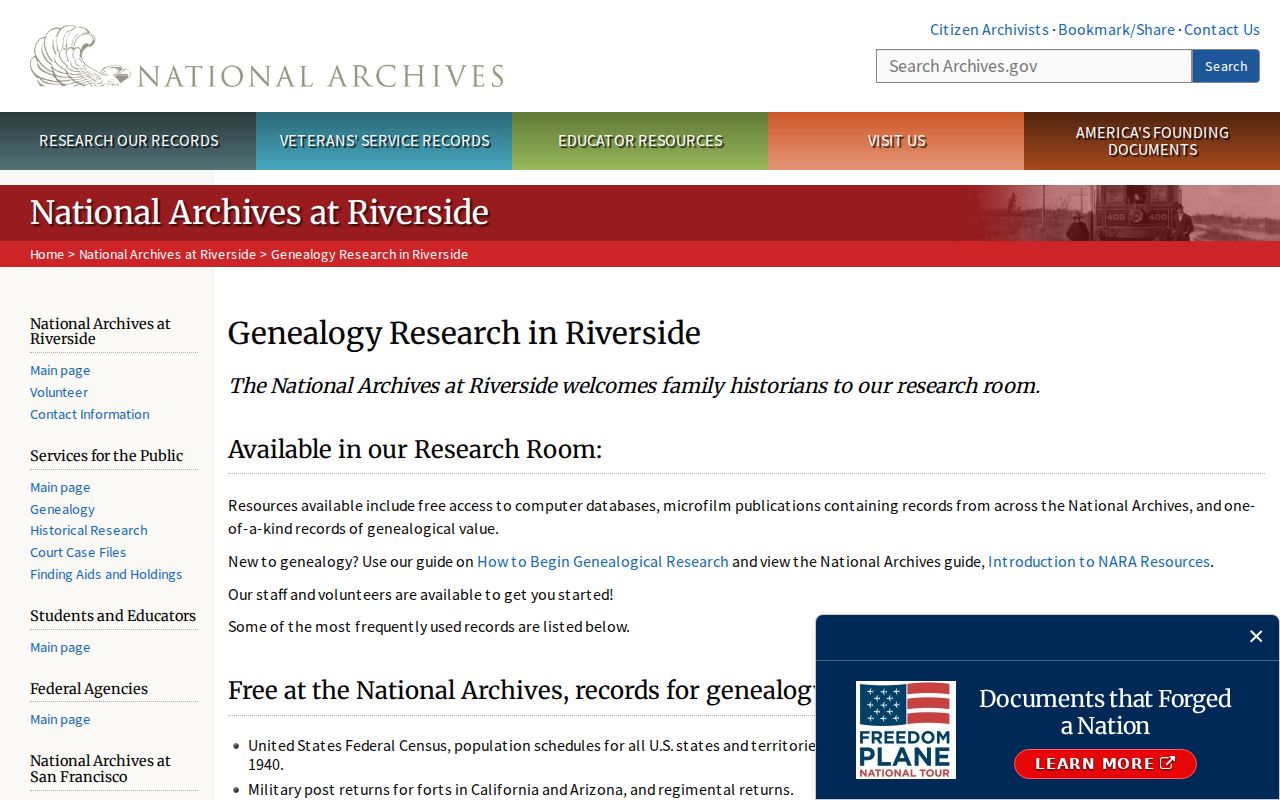
Schedule an appointment before relying on a series, because the correct record may be held at a different federal facility or require a fuller locality description.
Corona Companions to Eastvale City Directories
Newspapers, yearbooks, cemetery records, and digital memory collections fill the spaces between directory editions. They can preserve a face, school tie, residence, death notice, land event, or community connection that a volume did not capture. The strongest results keep the date and source type visible.
| Companion collection | Coverage | Useful clue |
|---|---|---|
| South Riverside Bee | 1887-1896 | Social, land, and school news |
| Corona Courier | 1900-1938 | Notices and community news |
| Corona Daily Independent | 1906-1983 | Dairy, agricultural, and resident history |
| Corona-Norco Independent | 1983-2003 | Suburban transition and local notices |
| Corona Newspaper Archive | 1887-1977 | Searchable on the library first floor |
| Sunnyslope Cemetery | 1895-1984 | Inscription, date, cause, and burial location |
| Corona Heritage Online | About 6,000 items | Yearbooks, portraits, residences, maps, and scrapbooks |
The Corona Heritage Online collection is particularly useful for reconnecting a name with school or community identity. It can be paired with CNUSD yearbooks because children from the East Vale area crossed the Santa Ana River for Corona upper grades. The collection is a historical companion, not a complete resident roll.
The Corona Heritage Online digital collections below show the kind of yearbook, portrait, map, and residence material that can supplement a printed entry.
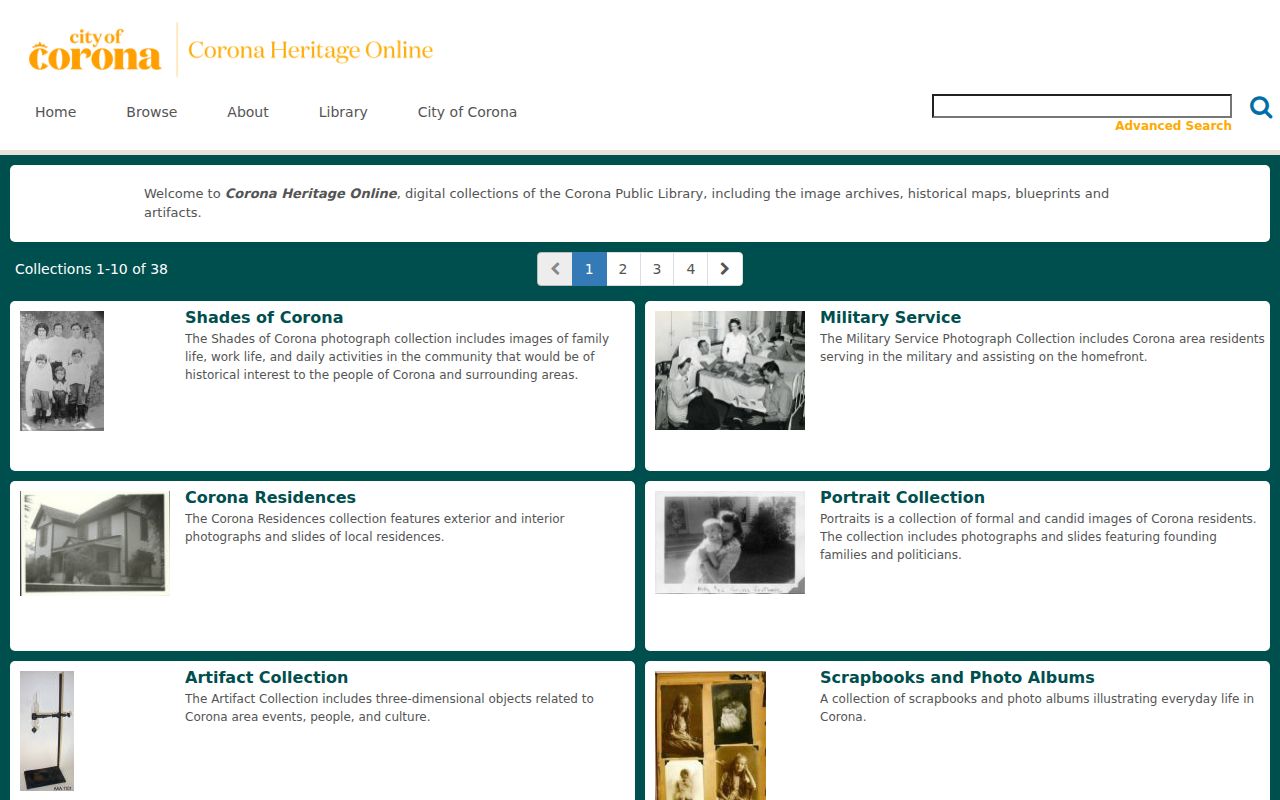
Digital memory items add faces and community context, while the printed directory supplies the dated listing. Keep the two source types distinct when recording a family connection.
California death and marriage indexes on Heritage Room fiche cover 1905-1939 and 1960-1985 respectively. Use them as discovery aids, then order a county or state record under California's authorized-versus-informational copy rules when a document is needed.
Eastvale Archives for Directory Gaps
The Robert J. Fitch Riverside County Archives is the offline bridge for land and county-government material that a city directory cannot supply. It works by appointment Tuesday through Thursday, 9 a.m. to noon. The research lists 951-486-7327 and CountyofRiversideArchives@asrclkrec.com for confirming a series, date span, and retrieval need. Holdings include assessment rolls, assessor maps, ownership records, deeds, homesteads, leases, mortgages, grantee and mortgagor or mortgagee indexes, surveys, plats, judgments, irrigation districts, and Board actions.
Bring a modern APN, legal subdivision, lot and block, map book or page, approximate owner spelling, and date. Ask which older series bridges the address rather than requesting everything about a street. Archives can establish land continuity; a directory, newspaper, census, or yearbook then supplies the household or community layer.
The Riverside County Archives holdings page is the source for the appointment and record-series route shown below.
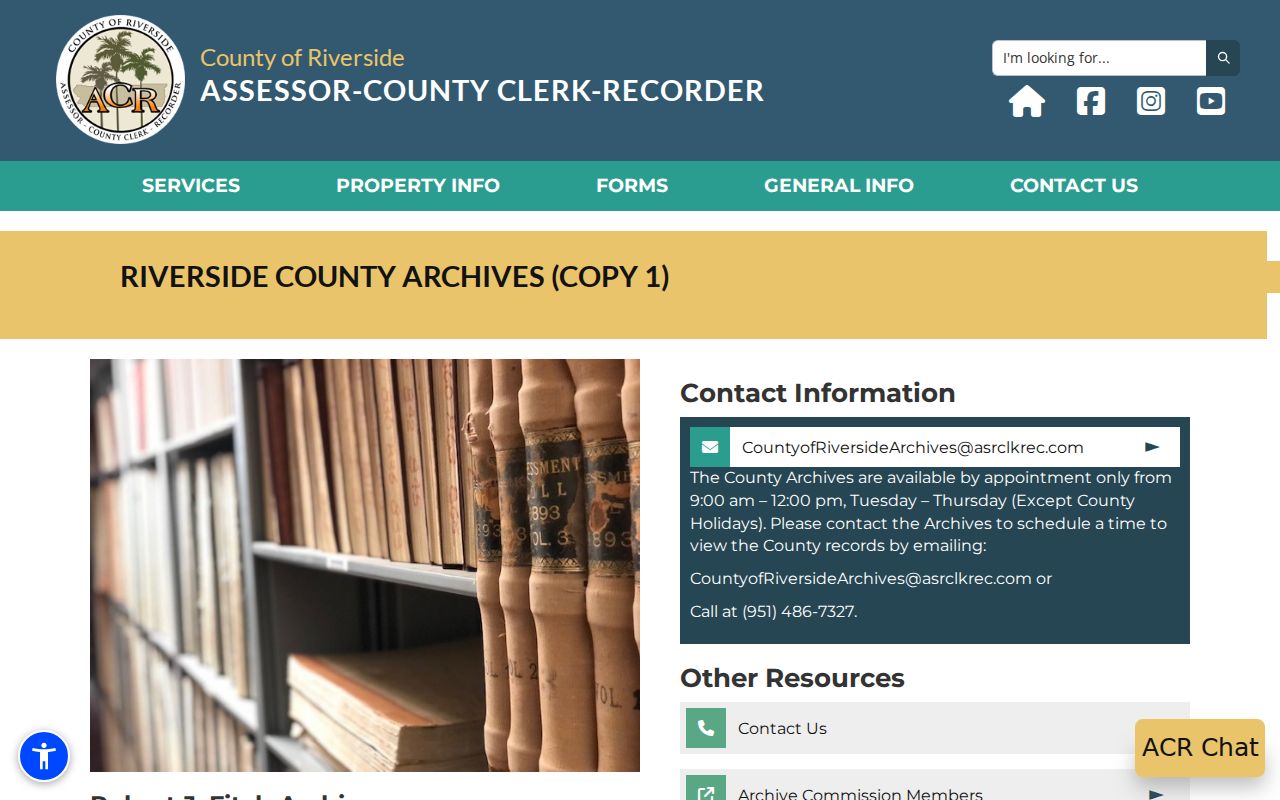
Older county records may use predecessor-jurisdiction language, so ask which county or series held the record on the date being researched. That is why a historical search for Eastvale is also a records-geography search.
Note: Heritage Room hours, scan fees, archive contacts, and collection coverage were checked in August 2026; confirm availability before travel.