
Finding Eastvale Residents by Record Type
There is no single current book of Eastvale residents. The trail splits by what each record proves. Riverside County assessment material links a parcel to an owner, but the public web search revolves around APN, PIN, and address rather than an online owner-name list. A recorded deed names the parties to an instrument. A voter record reflects a registration residence and election status. A court index identifies parties and case events. Vital certificates carry their own eligibility rules. The city clerk rounds things out with council, permit, and administrative records from the post-incorporation era. A name search runs in a different order than an address search. Start with the narrow fact you already hold. Keep the spelling and date. Treat each hit as a clue until a second source agrees. A directory line can suggest an occupant, while a deed shows an owner. Neither alone proves who slept at an address. The Eastvale residents directory stays most useful when it separates those roles and points each question to the custodian that actually holds the record.
- Use Riverside County Property Search with a street address or APN to establish the parcel identifier.
- Use California My Voter Status only for the named voter’s own identity-gated record, or request voter-file data for an approved purpose.
- Search Riverside County’s recorder index by party name, document number, type, date, or map reference.
- Use court, vital, business, license, or unclaimed-property sources only for the particular connection they can show.
- For earlier households, search Corona and East Vale variants in directories, newspapers, yearbooks, and census material.
- When an online path stops, make a defined request to the city clerk, county office, archives, or state custodian.
- Roll
- A recurring government list, such as an assessment or voter registration record, built for a stated administrative purpose.
- Index
- A finding aid that names a party, case, document, or event; the index is not the underlying image.
- Parcel
- A mapped unit of land identified by an APN, with a situs and legal description that may outlast a street label.
- Criss-cross directory
- An address or household-oriented directory format. No standalone Eastvale run was verified, so older county or Corona holdings need checking by year.
The Offices Behind Eastvale Resident Rolls
Eastvale records sit under more than one jurisdiction. Riverside County's Assessor, County Clerk, and Recorder handle property, recorded instruments, clerk-indexed documents, and county certificates. The Registrar of Voters administers election records. Eastvale's City Clerk keeps the municipal side, while Riverside Superior Court holds local trial cases because the city has no separate municipal court. These boundaries matter. A city request cannot conjure a county resident list, and a county property roll cannot name every household member.
Riverside County Recorder
Gateway Riverside
Riverside, CA
951-486-7000
800-696-9144
Riverside County Assessor
ACR public terminals
Riverside County, CA
951-955-6200
800-746-1544
Owner access is available at ACR offices and microfiche.
Riverside Registrar of Voters
2720 Gateway Drive
Riverside, CA 92507
951-486-7200
Riverside ACR answers its phone lines Monday through Friday, 8 a.m. to 5 p.m. Call that office for anything tied to county assessment rolls. For municipal matters, the Eastvale City Clerk sits at 12363 Limonite Avenue, Suite 910. That office takes email at cityclerk@eastvaleca.gov or calls at 951-703-4420, and City Hall keeps doors open Monday through Thursday, 7:30 a.m. to 5:30 p.m. Whichever record you need, reach for the office that owns the series rather than the one that simply carries the Eastvale name.
A Starter Path Through Eastvale Records
A clean search is a chain, not a pile of names. Begin with the smallest stable key. Add one independent check at a time. An address can yield an APN. An APN can guide an office owner lookup. A verified owner name can lead to the recorder. A bare name is weaker. A common spelling may join several people, businesses, or historical occupants into one misleading trail.
- Fix the question. Decide whether the goal is an owner, a registered voter, a recorded party, a historical occupant, an heir, or an affiliation.
- Save the first key. Keep the exact name, address, date, ZIP, APN, case number, or business number shown by the source.
- Cross the roles. Compare a parcel, middle initial, date, associate, business, or case number before joining records.
- Move to the custodian. Order an image, request a certified copy, or ask for a defined series only after the index result fits.
- Date the result. Processed-through dates, voter status, ownership, ZIP labels, and portal fields can change.
Note: An index result is a lead, while the underlying record and a certified copy carry different evidentiary weight.
Eastvale Property Search Starts with an APN
The Riverside County Property Search accepts three useful modes. These are APN or assessment number, PIN, and property address. APN mode takes the first nine digits, dash and final digit omitted. For the address field, a street number and name work best. A web result can identify the APN, situs, and assessment or tax context. Riverside ACR does not display owner names on the public web. Ownership is still public through ACR office computers and microfiche. That is a change of channel, not proof that owner information is secret. The split between situs and mailing address guards against a common error. Situs is the property location. Mailing address is where correspondence goes, and it may be elsewhere. A match can support an owner-occupancy guess, but it never builds a household roster. A mismatch may hint at an offsite mailing contact. It still names no one at the property. The full address-to-parcel chain lives on the Eastvale street directory page. There the address widget and street workflow stay central. The Riverside County Property Search page displays the public APN, PIN, and address entry path used before an office lookup.
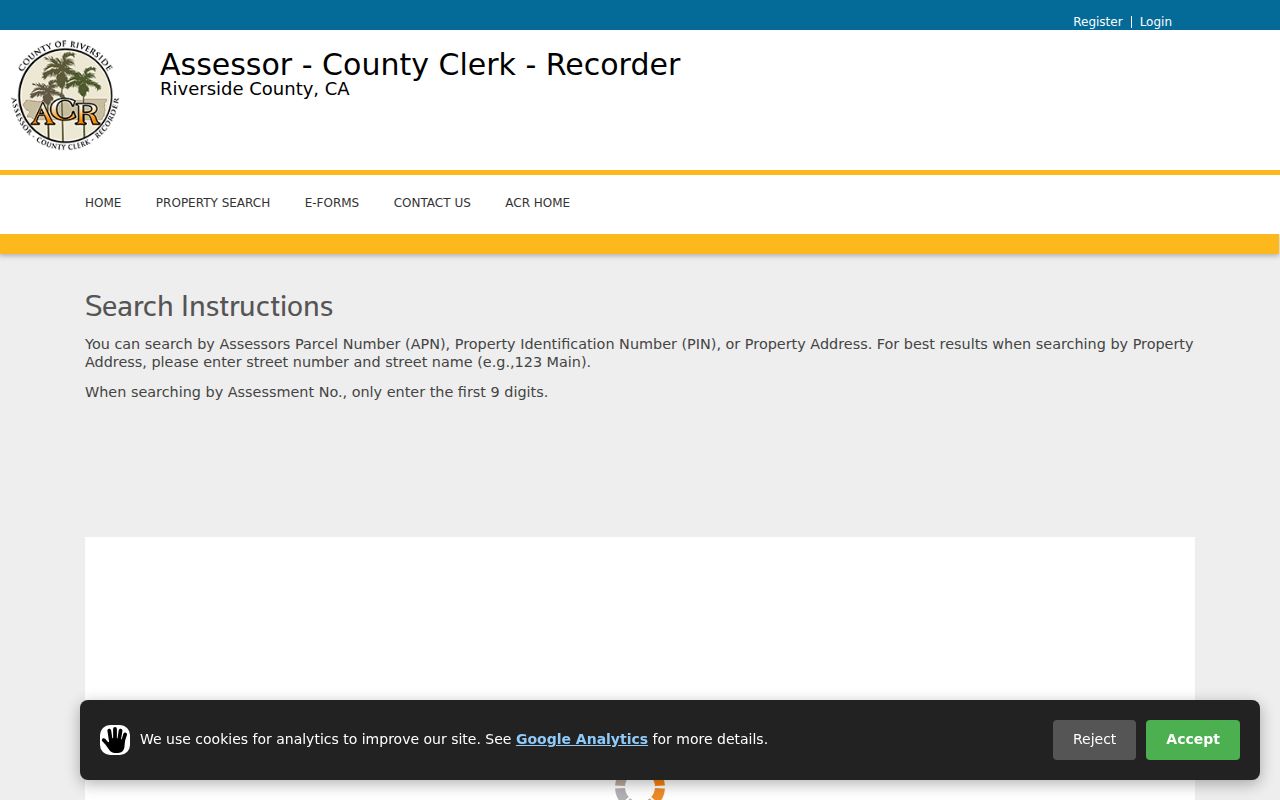
That split between web parcel research and office ownership access keeps an Eastvale residents directory result precise: it lists exactly what the source exposes.
| Property search field | How Eastvale research uses it |
|---|---|
| APN / Assessment No. | Enter the first nine digits without the dash and final digit. |
| PIN | Use the property identification number when the parcel record provides one. |
| Property Address | Use street number and street name; carry the returned APN forward. |
| Owner name | Not displayed online; use ACR office computers or microfiche for public ownership access. |
Note: An assessor roll lists taxable property and ownership evidence; it does not certify who currently occupies the situs.
Eastvale Voter Records and Limits
California My Voter Status works as an identity-gated self-lookup. You enter your own first and last name and date of birth. Where available, you also supply a driver license or ID. The last four digits of a Social Security number go in as well. What comes back is your own record. It can show registration status and address. Party and language preferences appear too. Polling place, upcoming election details, vote-by-mail or provisional status, and county contact information round out the display. Recent registration changes may need 24 hours to appear. This is a person checking their own record, not a public Eastvale residents directory.
Elections Code section 2194 limits voter-file access to election, scholarly, journalistic, political, or governmental purposes. An approved file may include name, date of birth, registration date, and residence and mailing address. Precinct, contact information, and party preference may also appear. Inactive voters must be requested separately. A statewide file costs $100. A specific-voter request covering up to ten named voters costs $30 per record. It is capped at $100, with county fees varying. A request for named voters can never become an unidentified street list. Driver licenses, Social Security digits, unique identifiers, and signatures stay excluded.
The California My Voter Status page displays the identity fields that keep the self-lookup private. A failed match may just reflect a spelling change, recent processing, or a missing identifier. The sensible fallback is the Riverside Registrar, not repeated guessing at another person's data.
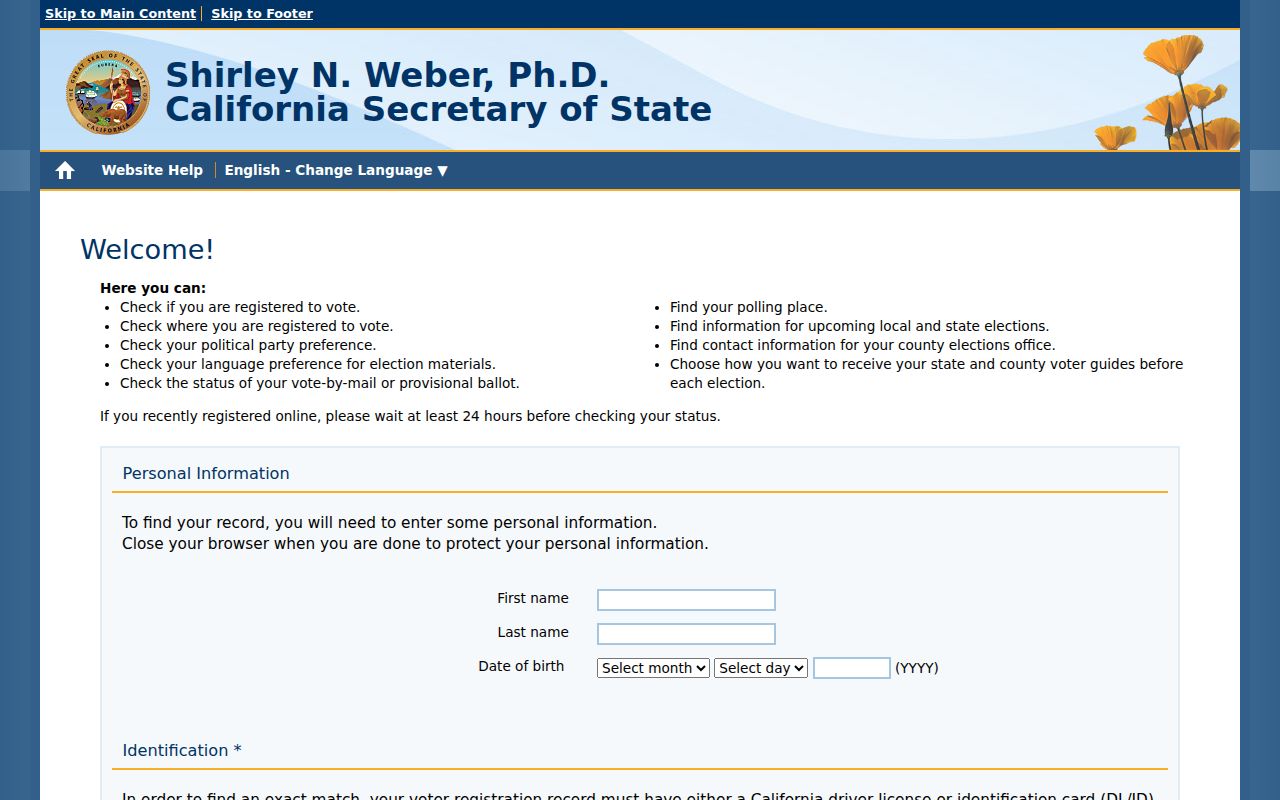
Voter information can confirm a dated registration connection where access is authorized, which gives a lawful personal search real value. It still cannot supply an unrestricted street list or any continuous record of physical presence in Eastvale.
Riverside Courts in an Eastvale Resident Search
Riverside Superior Court's public access path covers Civil, Criminal, Family Law, Probate, and Traffic cases. Eastvale has no municipal trial court of its own. The online name mode runs on credits. One name costs $1, five cost $3.50, and ten cost $5. Seventy-five cost $25, and 30 days of unlimited access costs $250. A clerk search costs $15 per name and returns case-number information only. Once you hold a case number, the register of actions beats a bare name hit. Any available documents help too.
Coverage differs by category and branch. Corona civil cases reach back to March 1994, and Riverside civil cases to October 1991. Family cases mostly reach April 1992, and probate mostly July 1994. Riverside felony indexing reaches January 1990, with misdemeanor indexing starting January 1994. Older, purged, sealed, or confidential material may not appear at all. Rule 2.503 keeps full electronic records for family, juvenile, guardianship, criminal, mental-health, harassment, violence, elder-abuse, and gun-violence matters at courthouse terminals. This holds even where an index exists online.
The Riverside Superior Court public access portal is a starting index. It is not proof of wrongdoing or confirmation that a party is the Eastvale person sought. Check party role, case type, branch, filing date, and case number. Do this before relying on any result.
Note: Federal matters use PACER through the Central District of California Eastern Division, while local trial cases use Riverside Superior Court.
Eastvale Vital Certificates Have Two Access Paths
California has no simple rule opening every old certificate after a set span of years. Health and Safety Code sections 103525 and 103526 split copies into two types. An authorized copy is one thing; an informational copy is another. Authorized birth, death, and public-marriage copies require a statutory relationship plus identity verification. Mailed authorized requests need a notarized sworn statement. An informational copy is stamped not valid to establish identity. It serves genealogy or reference purposes instead.
Riverside County is the practical custodian for county events. The California Department of Public Health provides statewide service within its stated coverage. County birth copies are listed at $34, and the state birth form at $31. Death copies run $26. Public marriage copies cost $19. The state's public-marriage coverage has gaps for 2000 and 2002 through 2007. Confidential marriage copies stay restricted to a party. Adoption originals generally require a court order. A no-record search keeps its fee. It produces a Certificate of No Public Record.
The California Department of Public Health Vital Records service lays out the statewide route. Use the county for a Riverside event when it is the proper custodian. Never treat a historical index as permission to obtain an authorized certificate.
- Birth certificates
- Riverside event records or CDPH; authorized or informational copies. County fee $34; state form fee $31.
- Death certificates
- Riverside event records or CDPH; authorized or informational copies. The listed fee is $26.
- Public marriage certificates
- The issuing county or CDPH’s stated years; authorized or informational copies. The listed fee is $19, with state coverage gaps for 2000 and 2002 through 2007.
- Confidential marriage certificates
- The issuing county; access remains restricted to a party. The listed fee is $19.
Eastvale Business and License Clues
A business filing or professional license can confirm an affiliation or an address. It can also confirm a public regulatory status. It is not a resident roll, and it should never be dressed up as one. California bizfile Online searches corporations, LLCs, limited partnerships, and nonprofits. A result can show the entity number, formation date, status, jurisdiction, street and mailing addresses, agent for service, standing, and statement due date. Statements, formations, amendments, and terminations may appear as free PDFs. The Secretary of State does not collect beneficial ownership. So an agent is a statutory contact, not automatically an owner or resident of Eastvale.
The Department of Consumer Affairs search accepts board or bureau and license type. It also accepts license number, business name, first name, last name, and registry number. Results can state current or expired status along with public suspension or revocation discipline. The Department of Real Estate and Alcoholic Beverage Control use separate routes. ABC can report selected license types by ZIP, which helps in Eastvale's overlapping postal geography. But a licensee or premises is still not a household.
The California business search page shows a public affiliation route. The California license search supplies a separate credential check. Compare entity, address, date, and role before linking any business record to a person.
A business filing, license record, or unclaimed-property entry can link a name to Eastvale at a specific moment. That kind of clue suits an heir search, a seller negotiation, a classmate hunt, or civic research. It works best when the record itself states the reason a person appears. Treat it as an affiliation, not proof of where someone lives now.
Current Eastvale Resident Sources
No single current source answers a residents directory question on its own. A parcel record pins down land identity and who holds owner access. A voter record is tied to identity rules and permitted purpose. A recorder index points to document parties rather than street occupants. Eastvale municipal records can surface a permit applicant. They can also surface a contractor, an agenda subject, or a released document. Business, license, and unclaimed-property hits add affiliation or past-address clues. None of them is a complete list of Eastvale residents.
| Source | What it can list | Keeper | Access boundary |
|---|---|---|---|
| Property search and ACR roll | Parcel, assessment, owner access | Riverside ACR | APN/address online; owner at office |
| Voter status or voter file | Registration residence and election fields | California SOS / Riverside ROV | Self-lookup or approved purpose |
| Recorder index | Deed, lien, map, and other instrument parties | Riverside Recorder | Free index; copy and certification fees |
| City Clerk and permit files | Municipal documents and address-keyed work | Eastvale City Clerk | Released records or defined request |
| Business and license search | Entities, agents, licensees, status | California SOS / DCA | Public affiliation record, not a household list |
Public rolls and commercial compilations are not the same thing. A public source has a named custodian and a stated access rule you can check. A commercial compilation may merge stale, copied, or mismatched data from anywhere. It can suggest a lead. It should never replace the custodian's own record.
| Source type | Best use | Limit |
|---|---|---|
| Official roll or index | Trace a parcel, filing, registration, case, or certificate through the responsible office. | Coverage, eligibility, fees, and privacy rules apply. |
| Commercial compilation | Generate a lead that can be tested against a named custodian. | May be stale, derived, incomplete, or tied to the wrong person. |
Eastvale's request route is built around three tools. These are "Submit a Public Records Act Request," "Search Public Documents," and "Search Building Permits." The Eastvale public-records portal costs nothing to use. Some dynamic form fields simply do not display every option until you begin. Frame a request around an address, a date range, a permit, an agenda item, or a released record. Ask the city to compile a person list and the answer will disappoint.
Eastvale Records Online and In Person
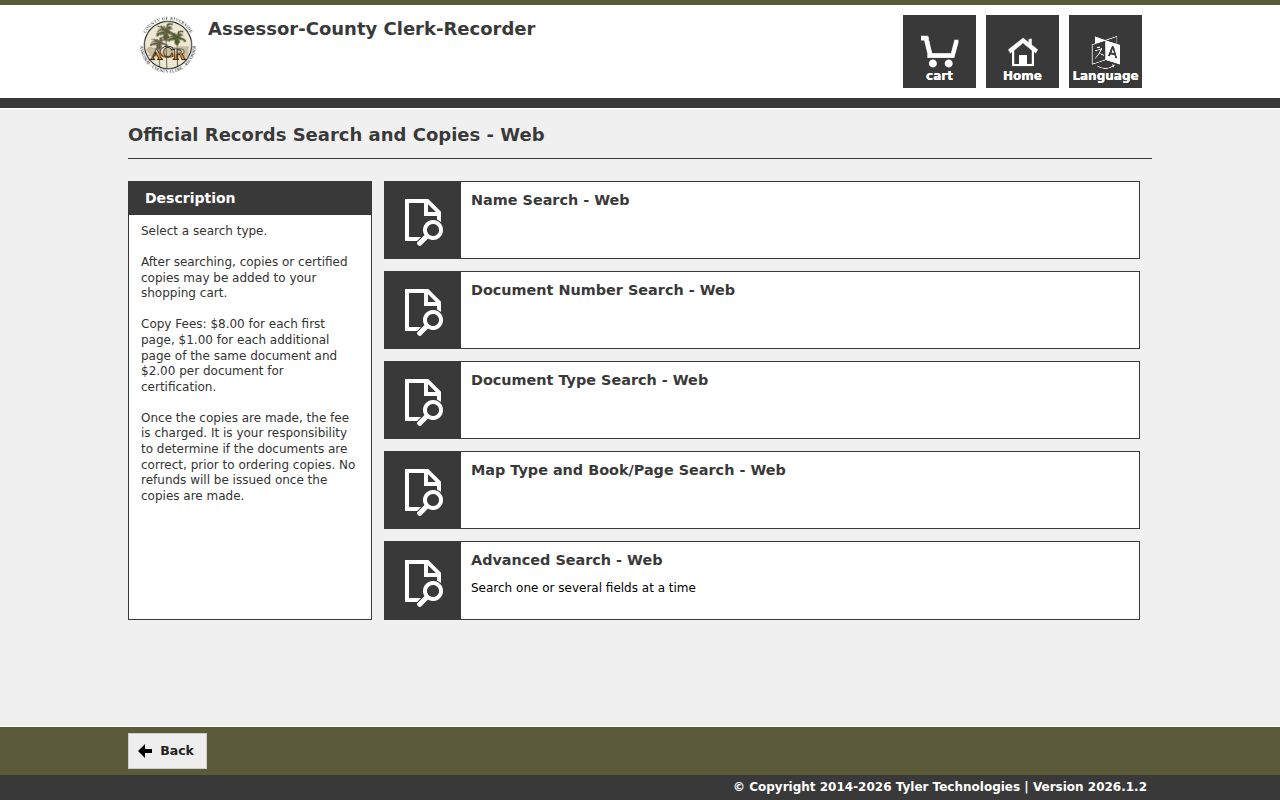
Online searching is a strong first pass, not the full records map. Riverside's recorder index opens on January 1, 1974, and its processed-through date keeps moving forward. Search modes include Name, Document Number, Document Type, Map Type, Book/Page, and Advanced. Names go in as LAST FIRST MI for individuals. Organizations are spelled as they appear. Exact matching follows typed order, while wildcard and fuzzy operators catch variants. The document image itself is a separate copy request.
Copies run $8 for the first page. Each added page costs $1. Certification runs $2 per document. Online card payment adds a 2.15% surcharge, and processing averages around 48 hours. Counter copies can be same day. Mail runs one to two weeks. A request lacking a document number should carry document type, parties, and an estimated date. Add any parcel clue as well. Before 1974, Gateway Riverside and the County Archives carry the trail. Eastvale history does not simply stop.
The Riverside official-record search landing page displays the available search modes at a glance. The county's posted route separates web, mail, counter, and certification choices for copies. Save the indexed spelling and the document number before paying, especially with a common surname.
Note: The stable recorder fact is the January 1, 1974 online start; fees, phone details, and processed-through status were checked in August 2026.
When Eastvale’s Online Trail Ends
California's Public Records Act, Government Code sections 7920.000 through 7931.000, lets any person request identifiable public records. The agency owes an initial determination in ten days. Unusual circumstances allow a written extension of up to fourteen more. That timetable governs the response, not instant production of every record. Inspection is generally free. Ordinary copies may reflect direct duplication cost, and extraction or programming can carry a charge. Exempt material gets separated where possible.
The California DOJ Public Records Act guidance helps frame a request well. For Eastvale, the city clerk is the right first stop for municipal records. Older ownership, assessment, grantor, grantee, map, or deed series belong to Riverside County ACR or the Robert J. Fitch Riverside County Archives, and staff can say which collection bridges the date. The archive works by appointment, Tuesday through Thursday, 9 a.m. to noon. Its holdings include assessment rolls, deeds, ownership records, homesteads, leases, mortgages, maps, plats, and indexes.
Riverside County Archives staff can confirm series, dates, and retrieval needs before a visit. Name an APN, a legal subdivision, an approximate owner, or a date. That beats a broad demand for everything tied to an address.
Protecting an Eastvale Address
California privacy rules narrow several records that might otherwise feed a public residents directory. Safe at Home offers address confidentiality to qualifying survivors of domestic violence, stalking, sexual assault, child abduction, elder or dependent-adult abuse, and trafficking. Specified threatened affiliates also qualify. Voter records for protected participants are omitted. The California Consumer Privacy Act gives rights against covered businesses. The state DROP process can push one deletion request to more than 500 registered data brokers. Neither tool erases a county deed or court file.
The real distinction is between a government record and a copied compilation. A broker deletion can strip a compiled profile where the business must act. It cannot rewrite the Riverside recorder index. Voter, offender, and court sources deserve the same care. Use public data for personal, lawful research. Good examples are family history, a property question, or reconnecting with someone. Never use a record to stalk, harass, intimidate, or harm another person.
Lawful-use limit. Eastvale records can support a focused personal inquiry, but a name, address, voter entry, or public filing is not permission to publish a household list or pursue someone who wants no contact.
Eastvale’s Historical Resident Shelf
Eastvale has no long shelf of printed directories under its own name. The city incorporated on October 1, 2010, far too late for that. Its paper trail instead runs through Riverside County. Corona, Norco, rural routes, and the older spelling East Vale fill in the rest. The Corona Public Library's W. D. Addison Heritage Room keeps Riverside City and County directories from 1889 through 1966 on microfiche. It also holds select Corona volumes, newspapers, cemetery material, and state indexes. The Library of Congress adds a free digitized 1893 to 1894 Riverside County directory. It was published in the county's founding year.
Visit the Corona Heritage Room genealogy collection at 650 South Main Street in Corona for the analog shelf. Hours run Monday through Thursday, 10 a.m. to 7:45 p.m. Friday has split hours, and Saturday is mornings only. Offsite material requires advance notice. Scans cost 25 cents, scan-to-email is unavailable, and a flash drive comes in handy. The 1893 to 1894 directory at the Library of Congress serves page images, OCR, PDF, and IIIF. No East Vale line should be invented without checking the printed page.
The Corona Heritage Room collection image points to the county shelf that bridges Eastvale's directory years. For full collection coverage and reading methods, turn to the Eastvale city directory page.
A single entry may list a surname, given name or initials, an occupation, a locality or post-office label, a residence or ranch, and a cross-reference. Work through consecutive editions before trusting any household match. Then pair the entry with deeds, assessment rolls, newspapers, or census images. That is how a line becomes a person.
Why Old Eastvale Records Say Corona
Borders moved at different speeds. Postal routes, school districts, newspaper circulation, and municipal boundaries each shifted on their own schedule. So a Corona mailing line can still describe a parcel that sits inside Eastvale today. The northern 91752 area straddles Mira Loma and Jurupa Valley. Older directory pages may read East Vale, Corona, Norco, a rural route, or a county section rather than Eastvale. That printed label is evidence, not a defect.
Local history fills the gap. East Vale school records, Corona upper-grade yearbooks, dairy and ranch references, and the county directory shelf all explain why a modern city-name search misses earlier residents. Search locality headings alongside surnames. Remember that a directory canvass could precede publication. A missing household sometimes means the canvasser simply never reached it. Keep the place label exactly as printed. Then test the connection with parcel, map, or newspaper context.
Note: Eastvale’s record geography is date-sensitive because county, school, postal, and city identities overlap without being interchangeable.
Eastvale’s 1893 Records Story
Three threads come together in 1893. Riverside County was carved from San Bernardino and San Diego territory that year. East Vale already appeared in school and community history. A. A. Bynon's History and Directory of Riverside County, 1893-4 captured the new county. It did so in the county's founding year. That convergence anchors any residents directory search. The city of Eastvale did not yet exist. Before 1893, look for the right record under a predecessor county. From 1893 until incorporation, county series dominate the paper trail. After October 1, 2010, city and county records run side by side.
Modern growth adds its own layer. Eastvale grew from ranch and dairy land into fast suburban building after the late 1990s. Census QuickFacts counted 53,668 residents in 2010, then 69,757 in 2020. A 2024 estimate came in at 70,751. Population figures are not a resident lookup tool. They do explain something. An old city directory and a current parcel system can feel like different worlds. A sound Eastvale residents directory search fixes the date first. Then it picks the office, archive, or collection that existed on that date.
Note: Record geography changes at jurisdiction boundaries, so a gap in an Eastvale-titled source does not mean the person or property left the region.